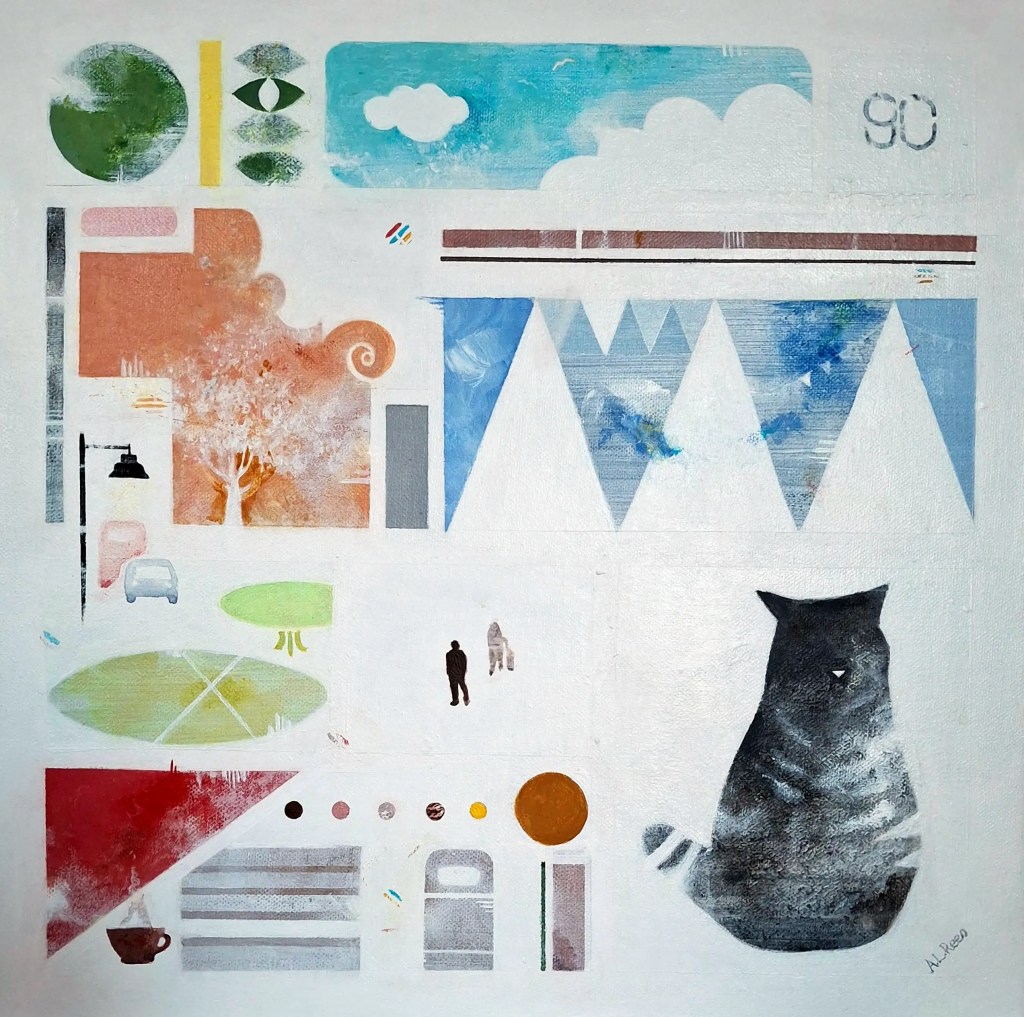
• No.s 3,4,5 & 6 – Morning Milk Run/Wash Day/Autumn Cat/Rainy Day

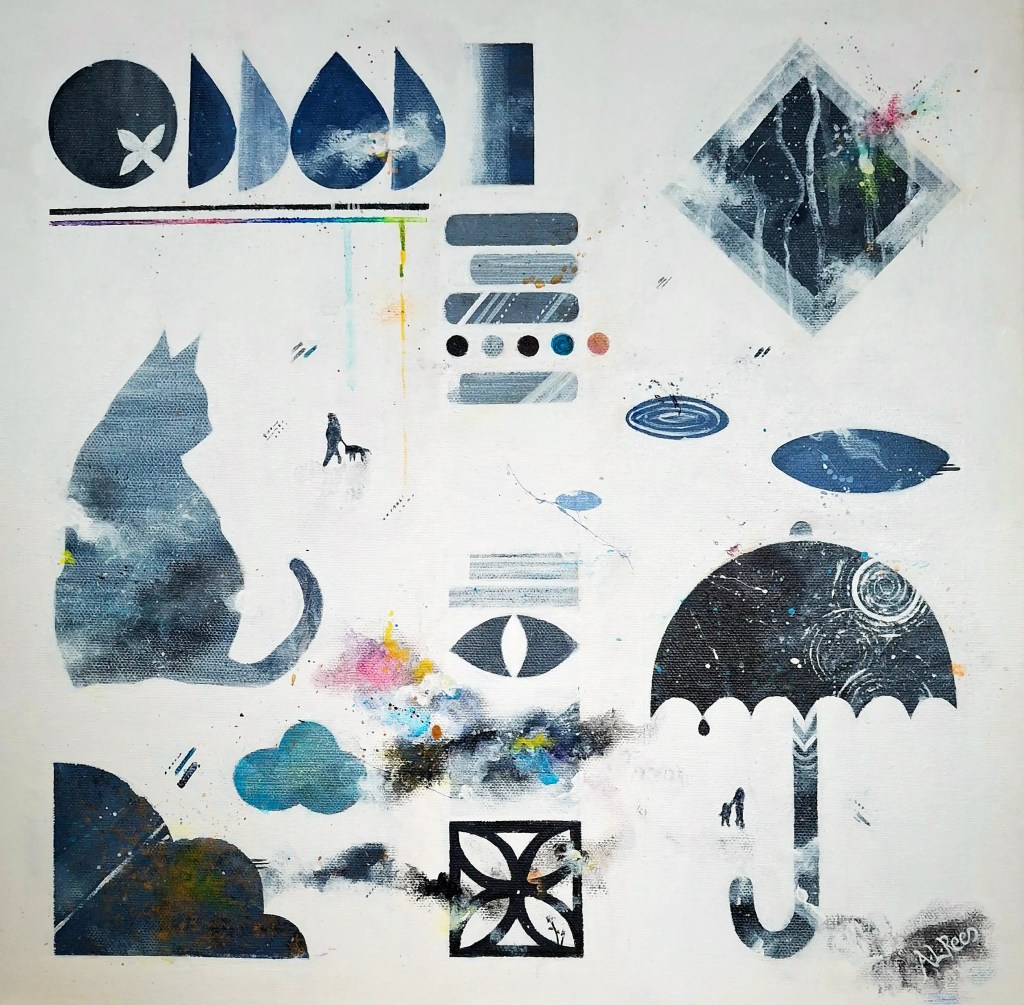
    The next four cats I paint are less specific cats in exact places than emotional memories, or composite landscapes. Three of them look back. The fourth, I’m only beginning to understand, looks in.

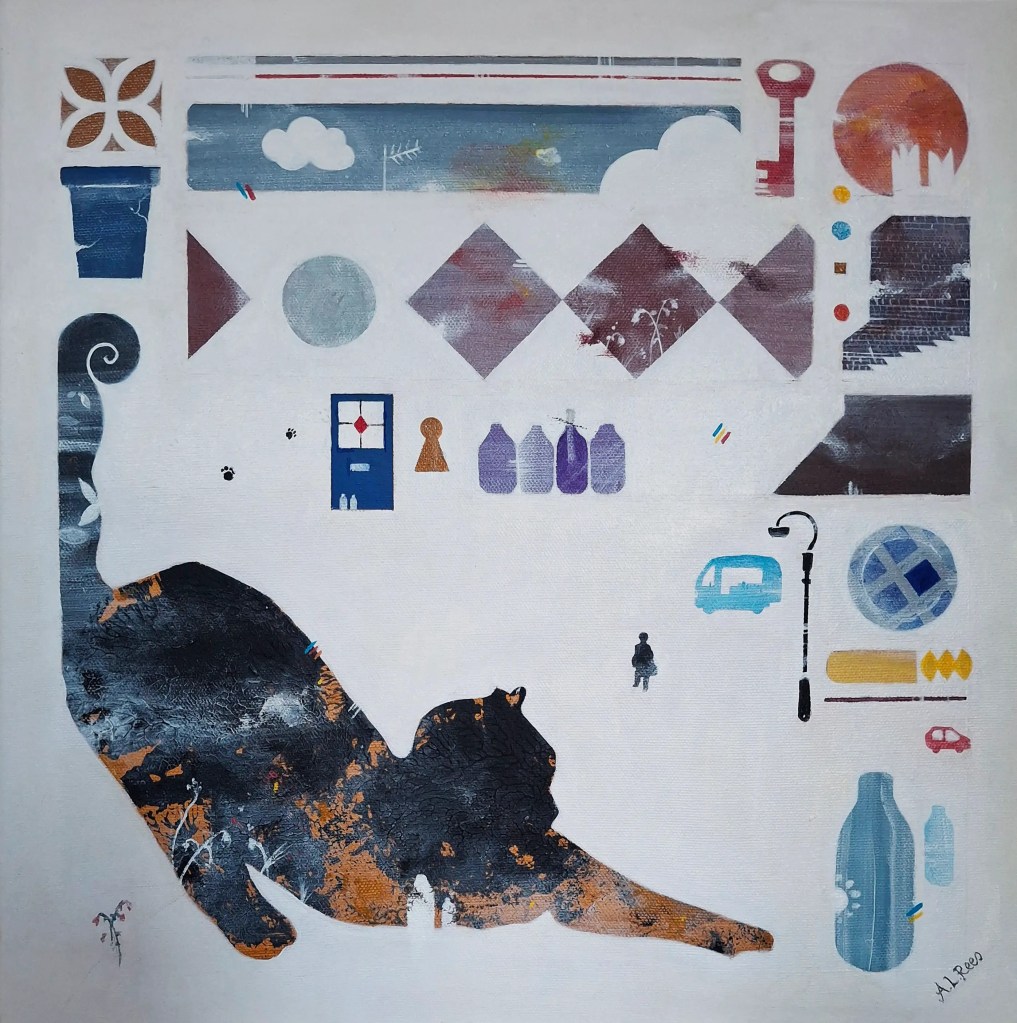
    The first is a nod to my childhood. Morning Milk Run shows a cat stretching outside our old front door while the milkman does his rounds. I kept the colours soft and muted and blended suburban vernacular (mid-century breeze blocks, flowerpots, old-style milk bottle tops) to give it a decorative feel, as if the cat could be real or a glazed pottery garden ornament. Only now, writing this, do I realise the cat resembles my childhood cat, a dark-furred tortoiseshell. A pleasing coincidence.
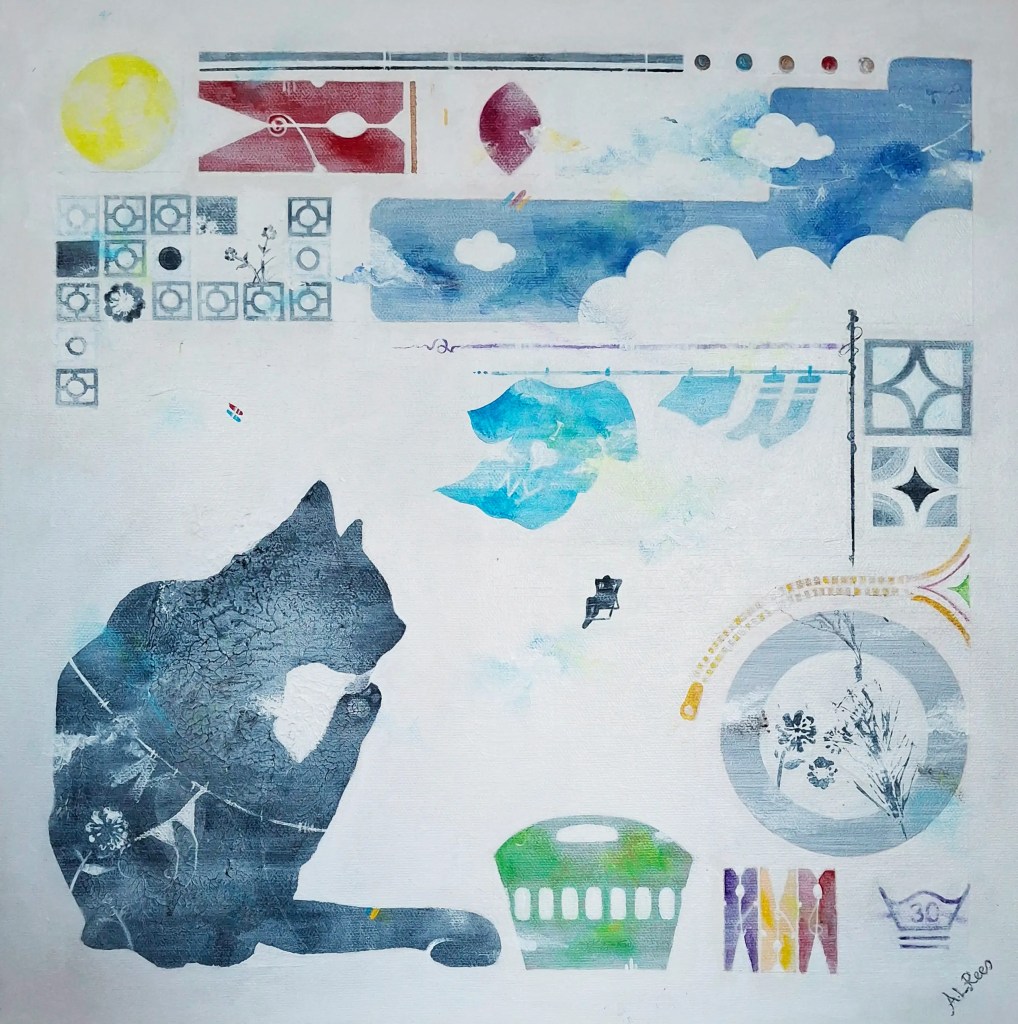
    The second, Wash Day, captures a sight familiar from my neighbourhood: long lines of washing in communal gardens in summer. I wanted the colours fresh and “washed out” to match, and of course there had to be a cat cleaning its paw on the lawn. I picked dried poppy seed heads from outside my house to use for printing, the peppery seeds spilling onto the table like dust.
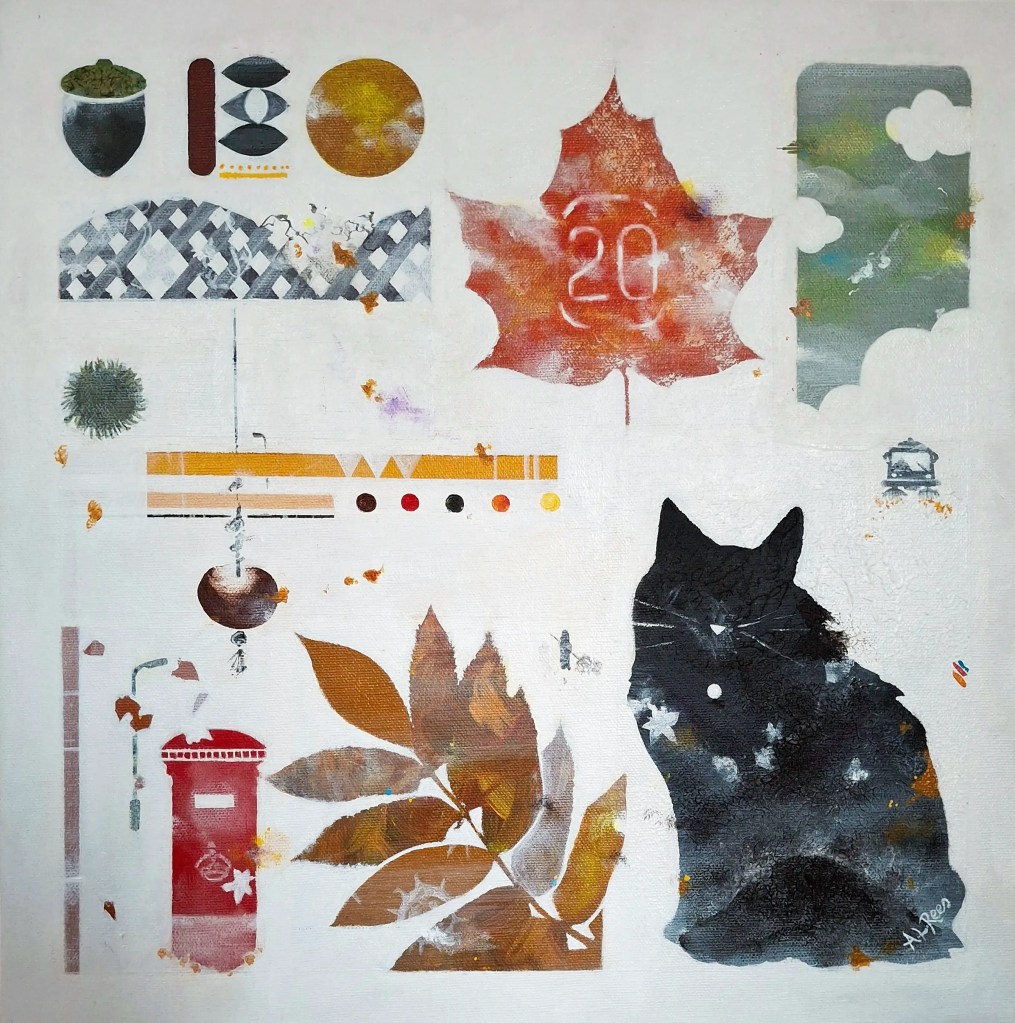
    Third is Autumn Cat, another homage to old times. Come September, like over-sized, over-excited squirrels, we’d be out collecting huge carrier bags of conkers from the park, only to take them home and leave them to rot in the back garden. The cat is based on a fluffy one I walked past, with bits of leaf and twig stuck in its bum-fur. While adding the street sweeper, I realised I’d like these paintings, or some of them at least, to be a small recognition of the hard-working people who keep our everyday suburban lives running smoothly.
    Last is Rainy Day. I’ve always loved being out in the rain, and so does my daughter. Cats disappear in the rain, so imagine this one indoors, looking out of the window at the watery world outside, perhaps wondering when it can venture out again. I painted my first five cul-de-sac cats without too much trouble, but Rainy Day sat there quarter-finished for weeks on the small easel in my kitchen. I blamed the encroaching cold and the busyness of back-to-school month. Perhaps, I thought, I was just getting tired of painting cats.

    But I know what was really happening: the same old, pernicious doubts, stalling me and determined to thwart me. You can’t do this. You’re exposing yourself. Stop now, before you get hurt. My will dried up, as did my acrylics in their tubes and pouches, a pathetic fallacy if ever there was one.

    Then, one Thursday, I decided enough was enough. I dug out the hardened plugs in my paints and got to work. Time that had stagnated suddenly flowed and dissolved as I mimicked rain with splashes and sprays of paint. I struggled over how much colour to add to the blues and greys, finally settling on a wash of pink, yellow and blue to suggest the iridescent shine of oil on wet asphalt.

    When I finished, I was happy with the painting’s introspective, slightly surreal feel. Only now do I see who the cat at the window is. She’s waiting for the weather to change, and so, it turns out, was I.
  • No. 2 Summer Cat

    No. 2 Summer Cat

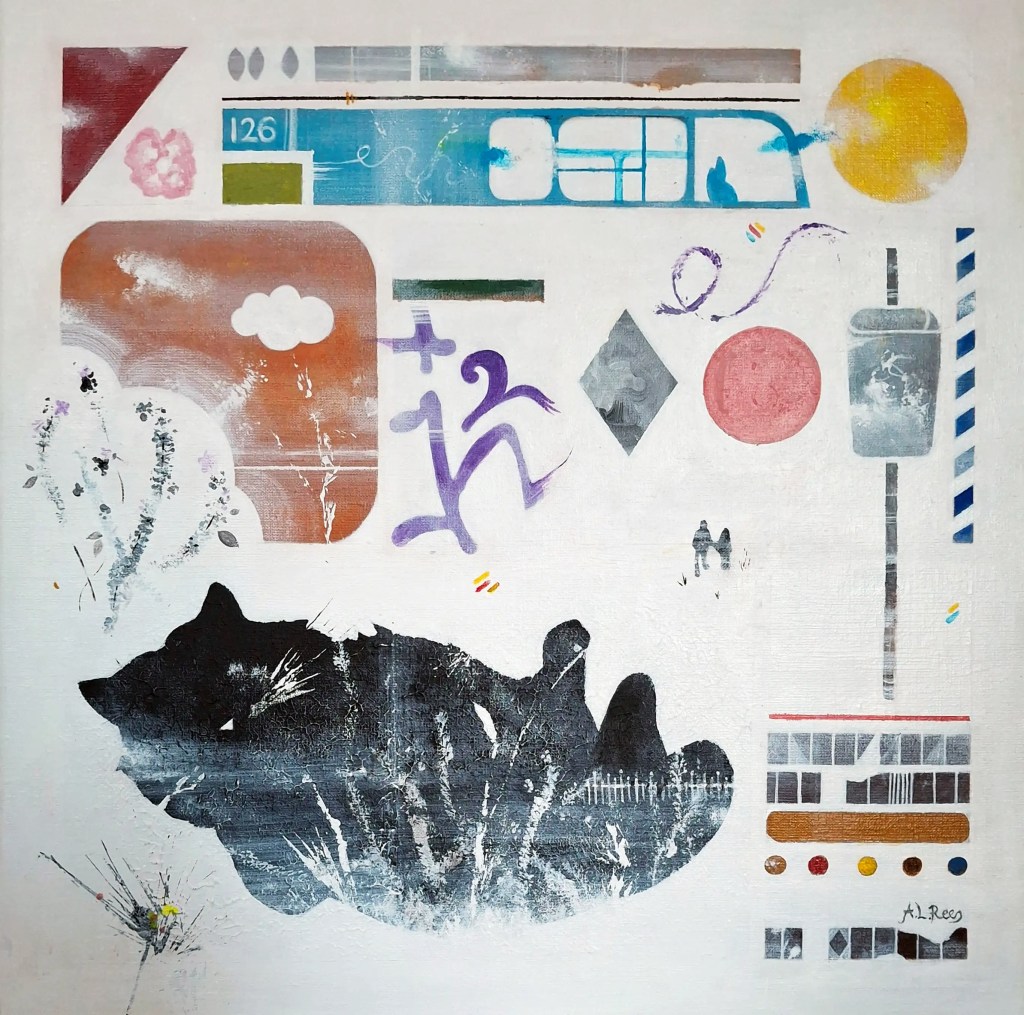
    The cat is black and fluffy and, it announces by rolling on its back in the parched summer grass, keen to befriend us.

    I lean down to give it a pet. I’ve taught my daughter how to, and how not to, stroke a cat (stick to the head; avoid the belly, however tempting). I’ve also impressed on her the need to suss the cat out first. I tell her this one looks friendly, but she is still nervous, which is no bad thing: cats can be fickle and prone to the odd out-of-the-blue nip or scratch.

    I feel guilty that I can’t give her a furry companion of her own. Circumstances prevent it. “One day,” I tell her. For now, we content ourselves with spotting the neighbourhood cats on our walks and giving them names (Spot, Torty, Rat-Cat, Brooke…). We’ve got to know their personalities. Some recognise us from afar and trot up to greet us. Some duck for cover under the nearest car. Others remain simply aloof.

    Today we are on the small slope of grass beside the square parking area, where some steps lead up to the main road. It’s a threshold space, a transit point where quiet neighbourhood turns into busy thoroughfare. At this time of year, it is spattered red, pink and purple by the poppies and other flowers planted near the wall, which displays a spray of lilac graffiti. On the path lies a flattened, stripy straw.

    It must be hot, I think, all that thick fur in the sun. Yet there the cat is, utterly unbothered, a winter coat on a summer day, rolling happily in the desiccated grass. It seems a shame to let the moment pass, so I decide to paint it.

    And so I embark on the “difficult second painting”, hoping I am not a one-hit, or one-cat, wonder (if I ever was that).

    In some ways, it is smoother sailing than my first voyage: I’ve learnt an artistic grammar, or style, that works and can be adapted. But I’m keen not to replicate. I want each new painting to be different from the last, to tell a new story and capture a unique feeling. I return to the spot, take some photos, and pick some grasses to print onto the cat, which, by happy accident, turn out looking like whiskers.

    I’m happy with the finished result, which has a colourful, comic-book feel. I like that this small, mundane space in suburban West Yorkshire has distinct Tokyo vibes: the steps, the lilac graffiti, and the bold, saturated colours could almost belong to a Japanese side street.

    We saw the cat maybe once or twice more, but never again at that spot. Perhaps it will return. Perhaps not. Either way, in the painting, it’s still there, rolling in the grass.

  • No. 1 The Cat on the Lane

    The cat on the Lane is something of a local celebrity. A luxuriant silver tabby, it likes to sit on the pavement outside the café opposite the bus stop, completely unbothered by the dogs, shoppers, and buses passing by.

    Why this cat chooses to frequent the Lane rather than stick to the safety of its own back garden seems contrary to expectation. But it’s easy to forget that cats are curious creatures, and that they come in all dispositions. Perhaps this one enjoys the hustle and bustle of the Lane, with its multitude of sights, smells, and hands willing to offer it a stroke. Perhaps some cats, like many humans, enjoy solitude in company.

    The fact that this particular tabby feels content and safe on such a busy thoroughfare is, I believe, a testament to the goodness of the Lane. If I were a cat, I too would choose this as my place.

    I have lived just off the Lane since I was four, and for me it is an avenue of happy memories: the gift shop where childhood-me bought hair bows, bath pearls, and furry stickers; the long-gone video shop; the once-upon-a-time newsagent with its stash of 1p foam shrimps, flying saucers, and chocolate mice; the bookshop where I worked in my early twenties, serving some of the Lane’s more colourful characters.

    I remember fondly the first Christmas they festooned the plane trees with fairy lights. These days, I’m most likely to be found browsing one of the two charity shops or eating a ginormous almond croissant from the bakery. But however old I get, however much life changes, whenever I step onto the Lane, I am eight years old again. It is Saturday. It is summer.

    The cat sits with its eyes closed as clouds, cyclists, and a big red bus roll by.

    It pains me, truly, to think that one day I will no longer come here. In many ways, I am already something of a tourist. My home is elsewhere now.

    So I set out to paint it: this extraordinary ordinary cat in this extraordinary ordinary place.

    Part-way through, I stare at the canvas. My inner critic, as always, is sneering.

    “This is rubbish. What’s the point? Why paint this?”

    One thing I’ve discovered that helps in these moments is to think of whatever I’m working on as a puzzle rather than an expression of my deepest soul; not a visual embodiment of all my talent, self-worth, and value as a human being.

    It’s just a puzzle. A visual puzzle. You only need to solve it, bit by bit.

    I tell myself this, and I’m able to crack on. Or paint on.

    When I finish, I am quite pleased. It feels as though everything is in harmony: the pieces slotted into place, the colours well calibrated, the cat a good blend of mystery and reality. I hope I’ve done them both justice.